

Almost all policy and research attention about AI’s economic impacts focuses on how AI will affect worker income. But household welfare is determined not just by income, but by prices. If I halve the prices of every good you consume, it has the same benefit to you as doubling your income. So how much could productivity improvements from AI reduce consumer prices?
Bottom line up front: I estimate that AI could reduce consumer prices by 28% – equivalent to a 39% income increase for all households.1 Half of this effect comes from indirect effects: AI reducing costs in back-office sectors like software and accounting, that flow through to everything else. The price reductions are dispersed across many sectors, and they scale with how disruptive AI is. The more jobs AI threatens, the more it reduces prices, acting as an automatic stabilizer against job loss. This is a back-of-the-envelope exercise with wide uncertainty, but it suggests AI’s price impacts deserve much more attention than they get.
Framework
Imagine a simple economy where we only make one good. 50% of the cost is labor, while 50% comes from other sources (machinery, electricity, etc). Suppose that AI can do 60% of the tasks that these workers do. This is equivalent to AI being able to do the job of 60% of workers. If AI can do these tasks for free, then labor costs fall by 60%. Since labor costs were initially 50% of the total cost, that means the total cost of production falls by 60% * 50% = 30%. Thus, AI reduces prices by 30%.
This framework glosses over many important assumptions that I’ll discuss at the end. But it establishes the approach I will use: that the price reduction in a sector due to AI = % of tasks that AI can do * % of costs from labor.
Weighting price reductions in each sector by how much households spend on that sector then gives us the average price reduction experienced by a household. That way, we put more weight on the prices of healthcare and education than on the price of artisanal soap.
There’s one final wrinkle. Even a sector with little exposure to AI might depend on another sector with high exposure to AI. Take plumbing as an example. AI cannot do the physical tasks involved in plumbing, so it might seem like it could not reduce the price of plumbing. But the company providing plumbing services needs to use payroll software to pay individual plumbers, accounting software to manage its books, etc. These costs are an overhead on every individual job, an overhead which AI can reduce. In this way, AI could reduce the price of plumbing even if it can’t do any of the tasks required of a plumber.
Accounting for these indirect price effects is especially important because AI’s effects are likely to be concentrated in back-end sectors that consumers rarely interact with. So we have to calculate not just how much AI reduces labor costs in a sector, but also how much it reduces labor costs upstream of that sector.2
Analysis
Full details on the data and analysis are in this GitHub repo.
What do AI exposure and labor costs look like in different sectors?
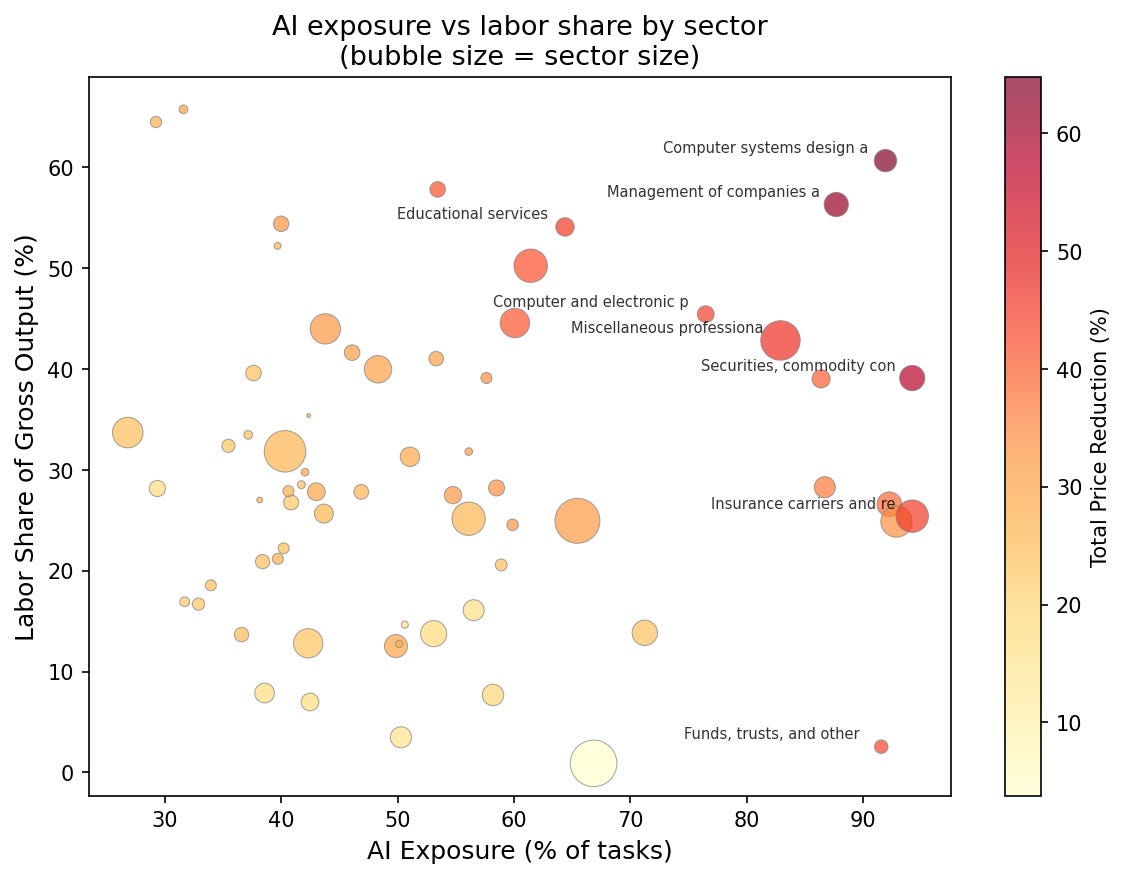
AI exposure is dominated by financial services and software. Insurance carriers and securities firms top out at 94% of tasks exposed, followed by data processing (92%), computer systems design (92%), and legal services (86%). Among the least exposed are sectors dominated by physical tasks: food services (27%), warehousing (29%), accommodation (29%), and mining (32%).
We can more systematically look at the sectors with the most potential price reductions from AI, including a decomposition into the direct effects (from labor costs in the sector itself) and indirect effects (from labor costs upstream of the sector).
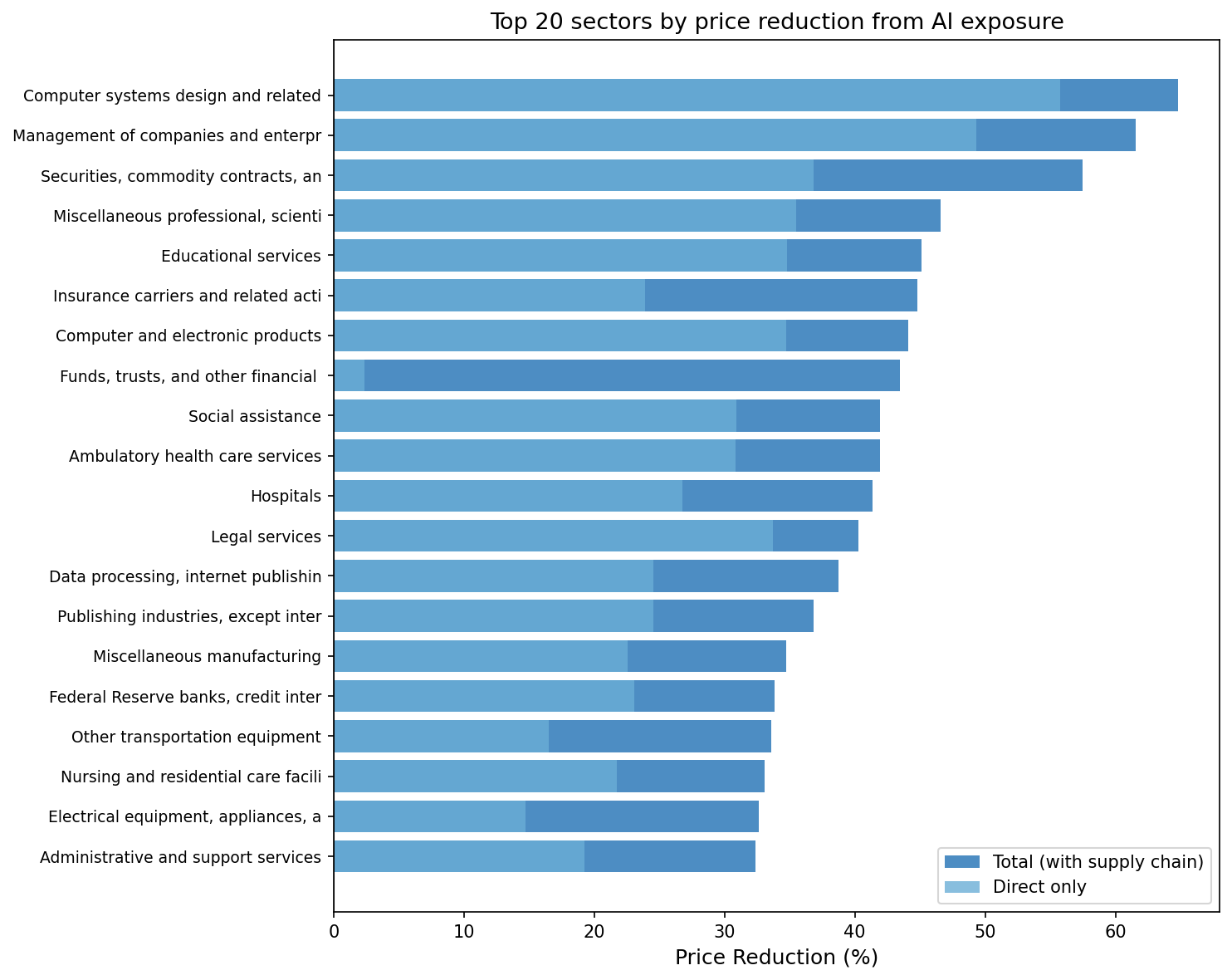
The gap between the dark and light bars points to the value of indirect effects. The most dramatic case is finance (funds, trusts, and financial vehicles), where almost the entire price reduction comes from cheaper inputs purchased from upstream sectors (in particular, software), not from AI replacing labor within the sector itself (because labor is a very small share of costs in the sector). Notably, even healthcare sectors appear in the top 20, buoyed by indirect effects from cheaper administrative, IT, and professional services inputs.
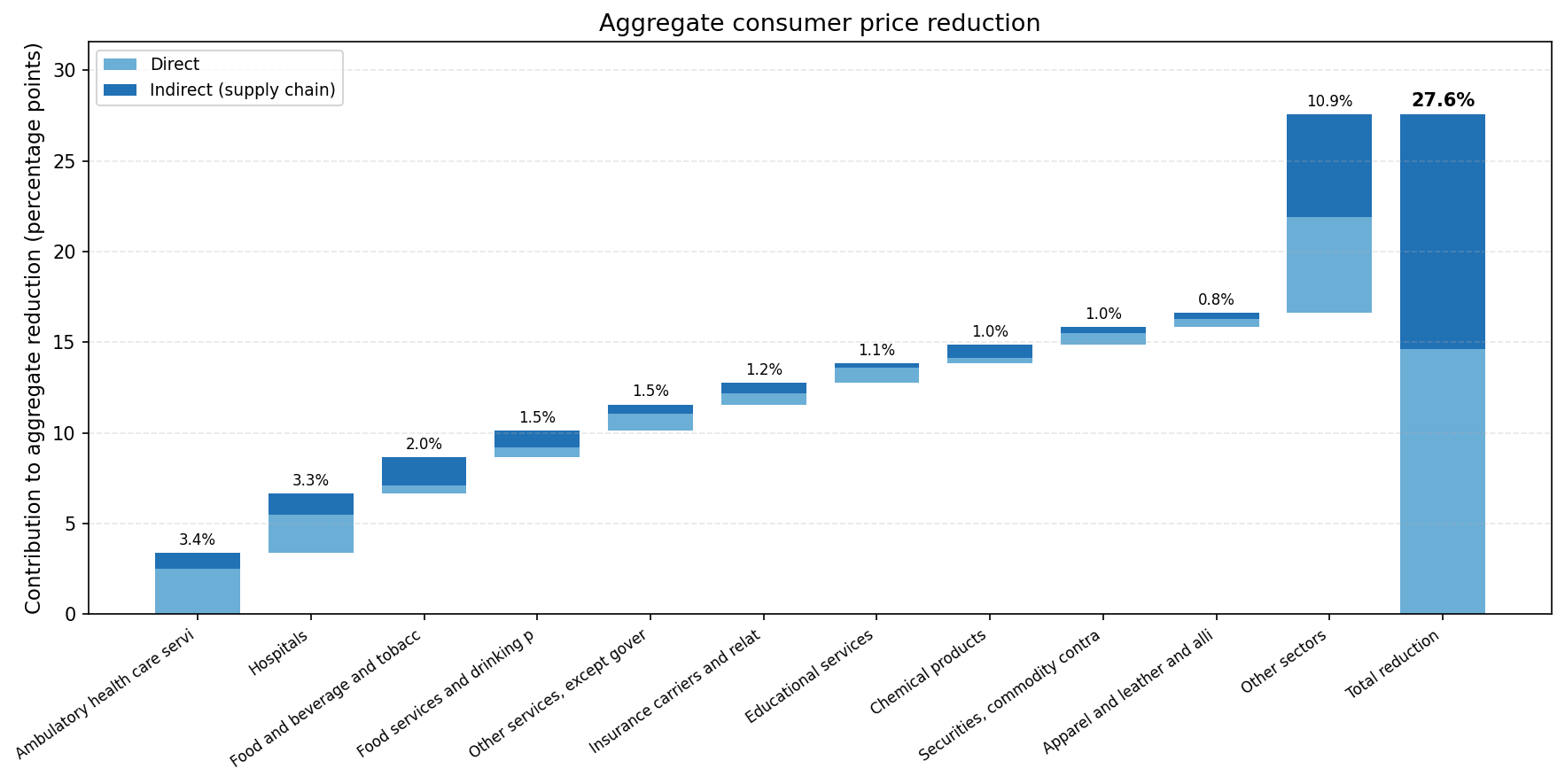
Across the economy, I estimate that AI will reduce aggregate prices by 28%. While software, financial services and consulting dominate the list of sectors with the highest price reductions from AI, they don’t actually contribute much directly to the price reduction, because households don’t spend very much on those sectors.
Instead, the price effects mainly come from healthcare, education, insurance, food and other services – familiar line items, because of how important they are in household budgets. But price reductions in these consumer-facing sectors come in part from the price reductions in upstream sectors like software. Builders of B2B SaaS products, be vindicated; your work does indeed matter.
To be clear, 28% is a big effect! A 28% reduction in prices is equivalent to a 39% income increase for every household. Put differently: any worker who sees their wages fall by up to 28% due to AI is still better off than they were before AI.3
Importantly, these price effects scale with the employment effects of AI – both price effects and employment effects depend on how much work can be automated by AI. The more economically disruptive AI is, the more it causes mass automation and job loss, the larger its price effects will be. Thus, AI’s price effects act as an automatic stabilizer to its employment effects, undoing (some of) the damage that workers face from automation.
Ways I might be wrong
There are a few ways in which my analysis predictably overestimates how much AI will reduce prices:
I’m assuming that the share of tasks that can be done by AI is exactly the share of labor costs reduced.4 But if tasks are complementary to each other, which seems more realistic, then automating some of them would still leave bottlenecks in other tasks. This dampens the efficiency gains from AI.
I’m assuming that cost reductions are passed through to consumers, rather than absorbed as profit increases by businesses.
I’m assuming that AI replaces labor for free. In reality, AI inference is costly, and that cost will add back to the price in each sector.
But there are also some ways in which I’m predictably underestimating price effects!
I use conservative estimates of the share of automatable tasks. Eloundou et al (2023) estimated AI exposure based on GPT-4, so their estimates of tasks that can be done by AI are more conservative than I would be now.
This exercise doesn’t capture the value of quality improvements. If AI can perform medical procedures more cheaply than doctors, it could reduce the price of healthcare; but if it can also perform better than doctors, then the quality-adjusted price falls even more than the sticker price.
Relatedly, this exercise doesn’t capture the possibility of AI creating new goods. If AI helps design new medicines that treat currently incurable diseases, that is worth more than reducing the price of existing medicines for that disease.
And to top it off, I could be wrong in even more ways with ambiguous directionality:
I’m not accounting for any equilibrium changes in supply and demand. Productivity changes will shift supply and demand, which then feed back into prices in a complex way. My advisors would cry if they saw the way I’m butchering equilibrium.
The data work is not bulletproof. Seriously, check my work. Claude Code made many judgment calls that I haven’t audited in depth. “Vibe research” still has a ways to go, and conclusions here could change.
Conclusion
Clearly, this exercise has wide uncertainty. I don’t expect it to be the final word on AI and consumer prices. But it is a provocation for people to pay attention to this topic, to give it even a fraction of the policy attention paid to AI’s labor market impacts.
A 39% increase in real income is an enormous effect, larger than any anti-poverty program – and it applies to every household, for free. In the worst case scenario where AI purely replaces workers and causes massive job loss, this price effect cushions the blow. In more moderate scenarios where AI transforms jobs rather than making workers obsolete, this price effect can lead to real income gains across the board.
If prices fall by 28%, each dollar buys 1/(1-0.28) = 139% as much as before, making it equivalent to a 39% income increase.
For technical readers: I’m using the Leontief inverse matrix to calculate the total effect of reducing labor costs in one sector, and how it propagates to other sectors.
Of course, a worker whose wages fall by 100% because they’re unable to find a job will certainly be worse off than before.
Technically speaking, this assumes that tasks are aggregated in a Cobb-Douglas function.
How will the 20-30% of people without jobs afford the goods, even at cheaper prices