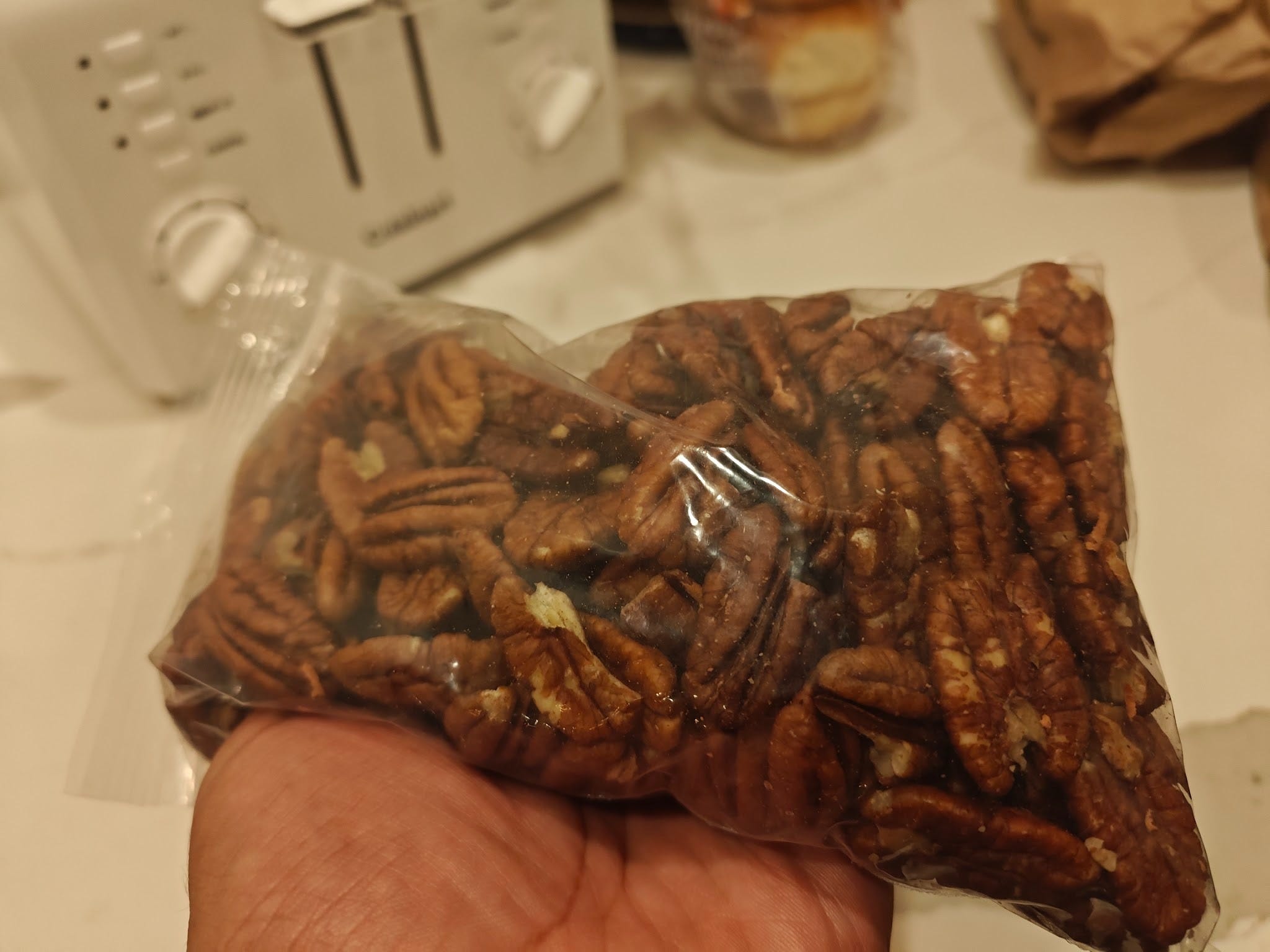
As a child, I didn’t know what a pecan was. I had never seen one or tasted one; they weren’t common in India. I had also never heard anyone say the word before, only read it in my mother’s recipe books, so I pronounced it “peck-in” until late into high school. To me, the pecan was just a language object. Just a word embedded in context, context that I could learn from examples, examples that lived in text. To me, the pecan was not real.
As an adult, I should understand pecans better; I’ve eaten plenty of them, and baked with them too. But I can’t shake the feeling that I don’t understand pecans any better than I understood peck-ins as a child. I still think of pecans primarily through associations: walnuts, almonds, praline, pie, ice cream, baking. When I think “pecan”, the words appear in my mind’s eye like text completions. But I don’t imagine the taste of a pecan; I don’t picture what shade of brown it is or its uneven ridges or how it catches the light; I don’t imagine the soil it was grown in. To me, the pecan is still not real.
In the past seven days, I have published 9,620 words, far more than the 3,500 I am required to. This is an important achievement for me. But it also fills me with dread. Industrial word production tiles my mind with translucent glass panes, each layer darkening the windows that reality filters through faintly. Every
Is this the fate of every writer?
In Lee Chang-dong’s 2010 film Poetry, the aging Mi-ja enrolls in a poetry class while dealing with early signs of Alzheimer’s. She starts to carry around a poetry notebook and make observations of the world around her. She also learns that her beloved grandson was part of a gang of schoolboys that raped one of their classmates, Agnes, who later committed suicide.
The premise of Poetry is grim. My friend rejected my recommendation, saying it sounded too depressing for him to watch. He wasn’t wrong, but I didn’t know how to tell him that Poetry is also one of the most uplifting movies I’ve ever seen.
The fathers of the other perpetrators push Mi-ja to talk to Agnes’s mother, to convince her not to press charges. On her way to have this dreaded conversation – which could determine the fate of her grandson – she is struck by the sight of apricots fallen beneath the trees. When she meets the woman, Mi-ja does not talk about condolences, or prison, or rehabilitation. Instead, she talks about the apricots full of yearning, throwing themselves to the ground to be crushed and trampled, preparing for their next life.
Mi-ja’s doctor tells her that her language is going to disappear, and that she will lose nouns first. As nouns disappear from her world, so does the web of associations that clutters her mind. If she saw the apricot as a noun, she might think peach, nectarine, jam. But without the noun, she sees apricots on the ground and thinks of the girl who threw herself into a river. She does not have to say – or even understand – that she is thinking about Agnes. Nor does Agnes’s mother need her to spell out what she means. What passes between them is nounless.
Mi-ja goes through the legal proceedings with a distracted air, enough that the other fathers – and you – start to believe that she is not all there. But it’s because she can’t stop thinking about Agnes. She goes to Agnes’s funeral, steals a picture of her to take home, goes to the science lab where the boys raped her, takes a long bus ride to the remote canal where Agnes committed suicide. The movie culminates not in legal consequences – those occur in the background – but in Mi-ja’s first and only poem, Agnes’s Song. She narrates Agnes’s farewell to the world. Halfway through the poem, the narration shifts, and we hear – for the first and last time – the voice of Agnes herself.
Writing can obscure what is real. But Poetry gives me the hope that writing can also guide me into the real, show me the path littered with crushed apricots. Maybe writing can make pecans real to me.