

AI slop is eating the world. AI has tripled new book publication in recent years, and virtually all of these new books are low quality. And we don’t even need to talk about Substack, where every other day there is a post with 5k+ likes and AI detection turned off.
But AI slop is not a problem with AI. It is an incentive problem caused by rewarding quantity over quality. To solve the problem of AI slop, internet platforms will have to tax the quantity of content, either explicitly or implicitly.
(Believe me, I appreciate the irony of making this argument while posting every day!)
Steam is the dominant PC game store, while itch.io is a smaller store, popular with indie and hobbyist developers. I scraped monthly game uploads on both platforms for the past five years. To see whether AI was affecting uploads on either platform, I projected the pre-2025 trend in uploads forward and compared it with actual uploads in 2025-26.1
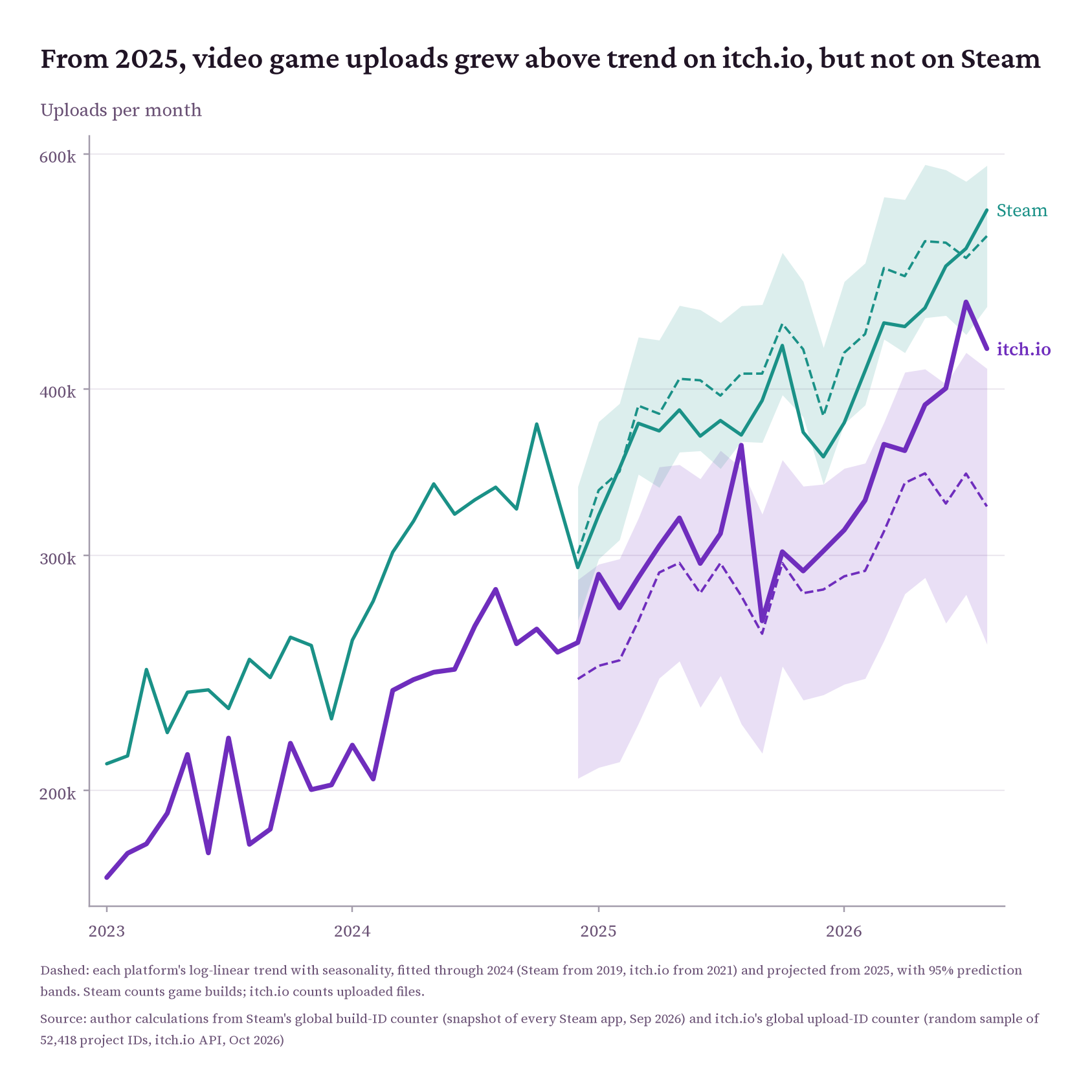
There were more itch.io uploads post-2025 than the pre-2025 trend projected. In contrast, there were fewer Steam uploads than its trend projected. The gap is noisy but substantial, with uploads growing 10% more slowly on Steam than on itch.io during the period when AI could contribute to video game development. This is striking because both are video game platforms, yet AI seems to have had a large impact on itch.io and no impact on Steam. Why?
I interpret this as the result of Steam’s submission fee. A key difference between them – and the main reason someone might not upload to Steam in the first place – is that you can upload a game to itch.io for free, while Steam charges a $100 submission fee for every new game. So when AI makes coding much easier, developers on itch.io are much more eager to create a quick slop game with it, whereas Steam developers have to stay discerning. There are other candidate explanations – for example, perhaps the itch.io developer pool is just fundamentally different from Steam’s – but such differences seem downstream of Steam’s submission fee.
This comparison gets at the core problem of slop: most platforms reward quantity. The more you post on Twitter, LinkedIn, or Substack, the more visibility you get, and the more subscribers you accumulate. If you publish a hundred AI slop books on Amazon, each one adds a little to your income.
The social problem with quantity is that every extra piece of content – good or bad – competes for our scarce attention. The problem with slop is not that it is bad or mediocre; it’s that slop crowds out good output. Thus, every internet creator benefits from posting frequently, but we as consumers don’t.
The solution is simple: platforms need to tax quantity instead of rewarding it. Sometimes the tax will be literal, as with Steam’s submission fee. Other times, it might be a shadow cost, such as an algorithmic penalty. For example, if YouTube recommended a channel less often because it posts a lot, that channel would become more judicious about which videos it publishes. The end goal is to get creators to prioritize quality over quantity, even though AI gives them the option to do both.
A tax is a handy solution because it leaves room for cases in which AI provides a lot of value rather than manufacturing slop. For example, I think video games should be using more AI than they currently do, like any software. If a game developer uses AI to turn their little pet project into an amazing game, they will be willing to pay the Steam submission fee because they can recoup it from sales. But if they make a rinky-dinky slop game that they expect essentially nobody to play, the Steam fee is a serious deterrent. In economic terms, the fee “screens” low-value content. This is also why Steam refunds the submission fee for games that make more than $1,000 – the policy is targeted at games that don’t expect to make that much.
Do I expect this shift to happen? No. It would be a very hard decision for advertising-driven platforms. YouTube is not being stupid when it rewards channels that post a lot. It does so because more videos give it more chances to make ad revenue. But we should be clear that platforms could solve the problem of AI slop if they wanted to – they just choose not to.
I chose 2025 as the break point so that the post period includes all possible periods where AI could have affected game development. My opinion is that AI could only really have started having an effect from 2026 onwards, so my specification is definitely conservative.