

For most of its history, AI safety has been a cozy professional circle: a tight-knit community of researchers, community-builders, and policy advocates in a few dozen organizations. But as AI becomes a national political issue, AI safety organizers are trying to meet the moment by expanding their outreach to the general public. 80,000 Hours has a YouTube channel with half a million subscribers, and MIRI’s Do Not Accept campaign asks people to add their names in protest to the ugly “terms and conditions” of AI development. The stakes of this mobilization are ramping up: a new Congress means new pushes for AI legislation, and civil-society organizing will grow around these efforts.
This is broadly good! It was never ideal that AI safety was a niche concern, and it’s encouraging that organizers are reaching out to the general public to make them aware of AI risk. But AI safety’s culture is not equipped for the tradeoffs of a mass movement, and it will be critical for us to harness this mobilization well.
Early signs of the mass movement
It might seem premature to call this AI safety’s mass movement era. Most of the time and energy in AI safety still comes from the same professional community that has carried it for years. Legislators and regulators are paying attention to the AI industry, but the general public is not yet feeling the salience of superintelligent AI.
But I expect that to change. The early signs are visible in the anti-data center movement. There were 142 protests against data centers in July alone, and data centers were a cornerstone of Abdul El-Sayed’s campaign. El-Sayed is now the most prominent elected official who made anti-AI policies central to his campaign, and he is likely the first of many. On the right, the conservative Humans First group called for a nationwide day of protest against data centers this summer. Of course, these protests were about water, jobs, electricity – not superintelligent AI. But they contain the seeds of an AI safety mass movement, through mistrust of AI companies and a suspicion that AI is harmful for society.
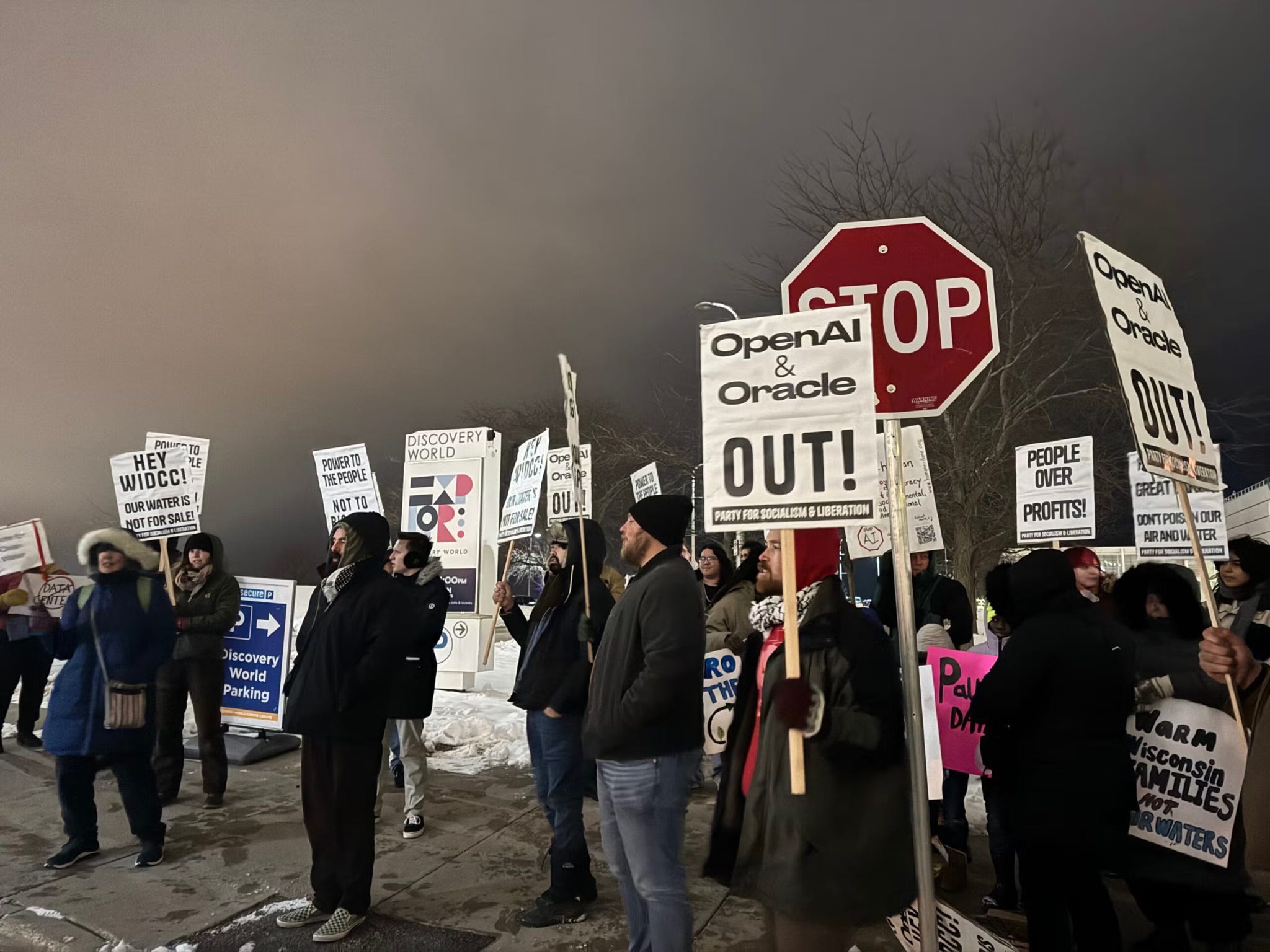
There has always been latent negative energy towards AI, but much of America’s activist energy over the past few years went elsewhere, primarily to the war in Gaza. But with the escalating pace of AI development, and the Democratic takeover of Congress making AI regulation much more likely in 2027, the returns to mobilizing people around AI have never been higher.
This is a disorienting change for AI safety, whose theory of change has been technocratic: either solve alignment, or persuade governments to reach an international agreement. Either way, the focus was on a few hundred singular actors – researchers, government officials, politicians – while the public was in the background. But all of this is going to change. AI safety is going to lose control of its own message, and gain a much bigger audience.
The promise and peril of a mass movement
Like AI safety, climate change originated as the concern of a small research community, and evolved into a mass movement. But as the climate movement grew, its public claims came loose from the science warning of a climate crisis. For example, in 2018, the IPCC said that holding warming to 1.5 degrees required cutting emissions about 45% by 2030 – a result that was popularized as “we have 12 years until the world ends”, despite climate scientists rejecting that framing. Similarly, the extreme high-emissions scenario RCP8.5 was often presented as “business as usual” even after it looked unlikely. The movement also got stuck in a loop of pessimism because of its existential anxiety. Good news, like the collapsing cost of solar power or lower emissions projections, was met with suspicion, treated as a distraction from the real work.
This is the failure mode of mass movements, and AI safety is susceptible to the same issues as climate change. It features a risk from the future that is hard to conceptualize. It has to build uncertain forecasts based on inherent uncertainty about the future. It arises at a time when young people are pessimistic and angry, and looking for someone to blame. All of these factors could turn AI safety into a movement that tries to frighten people with urgent claims. It could shed the careful reasoning of experts with risk estimates ranging from 3% to 33%, and paint them as confident that AI will definitely kill us all. If timelines to developing transformative AI are just a little bit longer than our best estimates, that could look like a total discrediting of the AI safety movement.


But AI safety is better placed than climate to avoid the problems of mass movements. Its goals are concrete and checkable: you can say what it would mean to build superintelligence safely, or to hold off until we can, and you could tell whether that had happened. Its policy asks, like a pause on AI development or an international agreement, are tangible goals. In short, it is hard to move the goalposts on AI safety, to redraw the map so that we are always in a state of crisis. This curbs the worst excesses of mass movements.
More importantly, a mobilized public gives safety advocates more arrows in the quiver. Whether the goal is an international treaty or a regulated pause on AI development, real public anger about AI makes that action much more likely to happen, and much faster if it happens. It gives lawmakers electoral reward for acting before the crisis, and thus makes sensible AI policy much more likely.
What organizers can do
AI safety’s mass movement era will be a big shift. Like climate scientists encountering the general public, we are not ready for it. AI safety has never had to persuade millions of people or watch its message be carried by people who are several degrees removed from AI safety research. Few AI safety leaders have experienced mass-movement politics before, and I fear we will not be ready to meet the moment well.
AI safety’s mass movement era could dramatically increase the chance of sensible AI regulation, if handled well. We will need to tie campaigns to specific goals rather than a general sense of dread, so that progress can be recognized. Above all, we will need to be careful about burning credibility on each new piece of information we learn about AI risk. There may come a moment, perhaps soon, when the public needs to believe a warning and act on it quickly. Whether people listen will depend on whether they trust that earlier warnings were accurate.