

Frontier AI systems are increasingly being used to accelerate R&D into future AI systems. This creates a positive feedback loop where the development of increasingly capable AI systems can aid in the development of even more advanced successor systems. Some version of this recursive self-improvement loop already operates today, with OpenAI and Anthropic reporting internal research speedups from using AI. If this loop becomes strong enough to sustain itself, the result would be an intelligence explosion – a self-sustaining acceleration in AI progress even without growth in compute or human researchers. So what are the conditions required for an intelligence explosion, and how likely is it?
I have a new paper tackling this question. (Believe it or not, I sometimes do research!) The most common story for an intelligence explosion is that AI progress could enable a new generation of agent researchers to push forward AI progress, even without the scaling of computing resources that has historically powered AI progress. If this new generation could make an even better model which was capable of pushing forward AI even further, then this could eliminate the need for compute scaling entirely – unhooking AI progress from the speed of the physical compute buildout, and allowing it to accelerate without limits.
But this common story is slippery! It conflates two different ways in which AI progress could feed back into itself:
Efficiency – better AI can do tasks more efficiently/cheaply, so that the same chips can power more agent researchers.
Capability – better AI can do more tasks involved in AI research.
In the paper, I show that separating these two channels is key to understanding the likelihood of an intelligence explosion. I use a simple model of AI progress to represent both capability and efficiency growth, and I derive the conditions for an intelligence explosion in this model. I find that an intelligence explosion requires both efficiency and capability to grow sufficiently quickly to support an intelligence explosion. Either margin on its own can be a weak link; neither can substitute for the other.
Using data on historical AI progress, I estimate that AI is probably getting more capable fast enough for an intelligence explosion, while its efficiency – how quickly it gets cheaper to run at a fixed level of performance – sits right at the threshold. Thus, better measurement of efficiency progress is the most valuable thing we could do to find out whether an intelligence explosion is coming.
A simple example
Imagine that AI research only involves two tasks: designing experiments and running them. Each task can absorb one researcher’s worth of time. AI progress is determined by the number of experiments designed and run. Imagine an AI lab with a single human researcher, and the chips to run 10 human-equivalent agent researchers. Agents can run any experiment they are given, but they can’t design new experiments; only human researchers can do that.
Now, imagine the researcher and the agents get to work trying to develop more capable AI systems. In this setup, the result of that research is 1 experiment. The human designs an experiment, 1 agent runs it, and the other 9 are idle, because there are no more experiments for them to run.
In this simple example, there are two paths through which AI improvements could lead to more successful experiments:
Agents could become more compute-efficient, so the lab can now run (say) 100 human-equivalent agent researchers with the same chips.
Agents could become capable of designing experiments, making them human-equivalent.
The first innovation is unhelpful; the lab is bottlenecked by the one human who can design experiments, so extra agents would be left idle. The second innovation is somewhat helpful – it gives those idle agents the ability to contribute by designing experiments, so now we can have 5 successful experiments rather than 1. But the real unlock on progress is when both innovations happen together. With 100 agent researchers who can also design experiments, we get to do 50 experiments rather than 5.
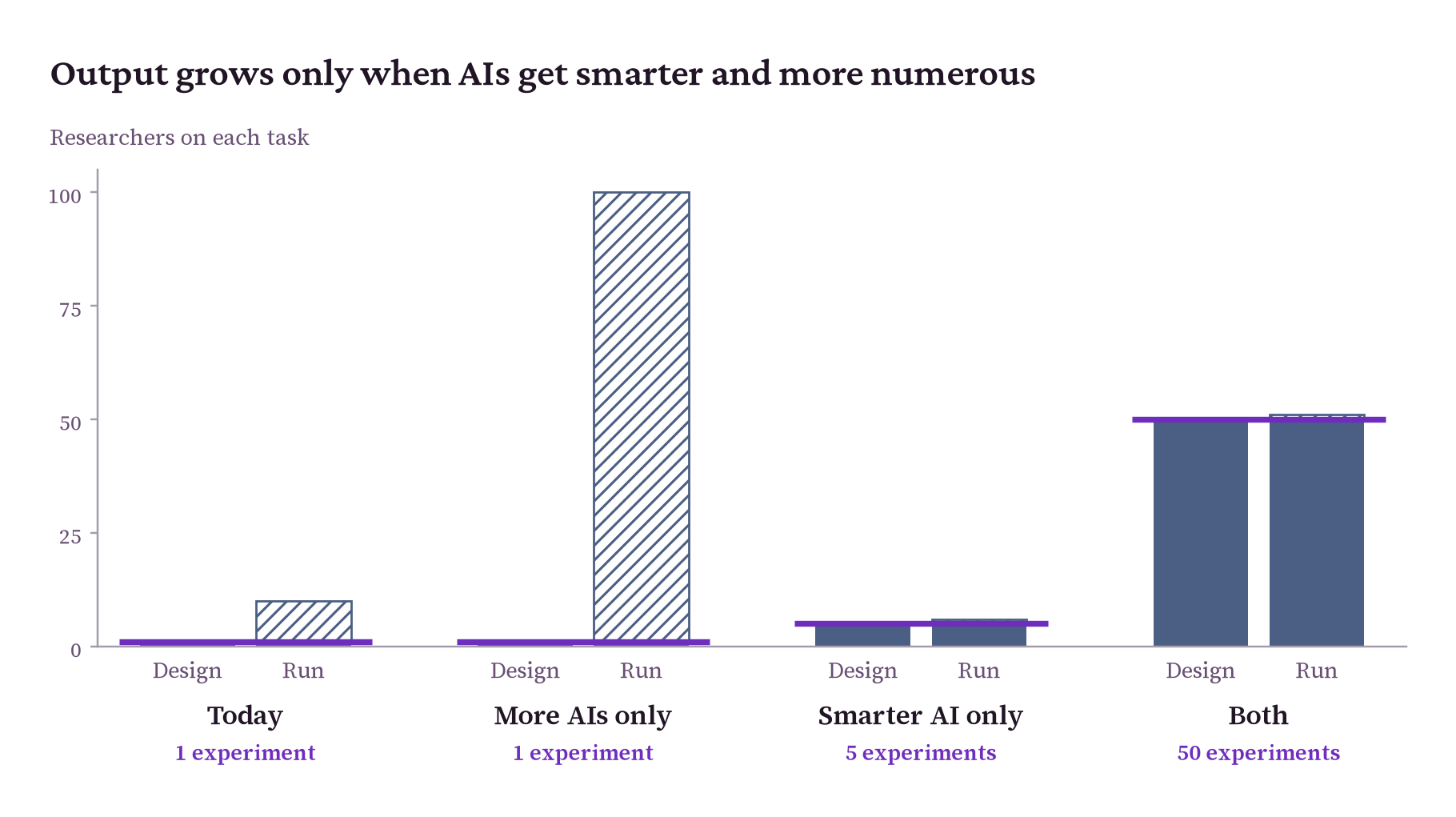
The takeaway from this simple example is that simply making AI more capable can unlock some AI progress, but it’s ultimately bottlenecked by the size of the agent researcher population: one human and 10 agents can only design and run 5 experiments. Conversely, simply making AI more efficient does little while humans are the bottleneck on research tasks, because the extra agents have to wait on the humans. It’s only when we combine both margins that AI progress can really take off.
The task-based view of AI research
The core insight of the simple example – that both capability and efficiency are essential for progress – holds even in a more complex picture of AI research. In the full model, AI research is made up of many tasks rather than two. Agents can do some share of those tasks and humans have to do the rest; the automated share of tasks is the measure of AI’s capability.1 Agents run on the lab’s (limited) chips; how many agent researchers this fixed stock of chips can support is the measure of AI’s efficiency.2 Task dependencies are less extreme than in the example; falling behind on one task slows the others down, but doesn’t negate them entirely. The lab’s research drives AI progress, which in turn makes agents both more efficient and more capable, creating a feedback loop that could support an intelligence explosion.
Even in this more general model, the pattern remains – rapid AI progress requires efficiency and capability to both be high. As a demonstration, the figure below shows research output across both margins: the number of agents per human researcher (efficiency) runs along the bottom, the share of research tasks automated (capability) runs up the side, and darker shading means more research output.
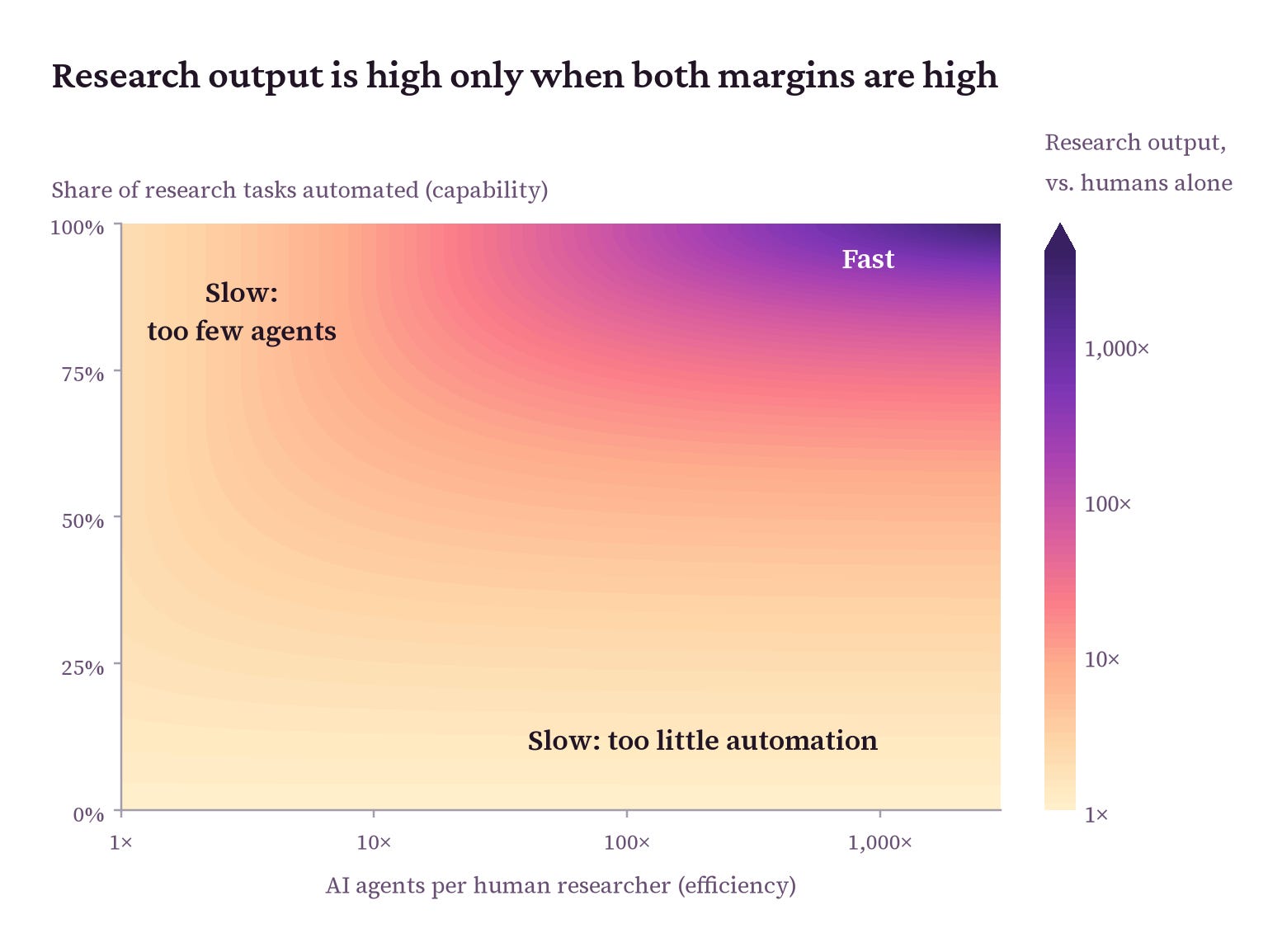
In the top left scenario, AI can do almost every task, but there are too few agents to do them all, so output stays low. In the bottom right, there are thousands of agents per human, but they can only do some of the tasks involved in AI research, so progress is ultimately bottlenecked by human researchers. Research output only takes off in the top right corner, with many agents and high automation.
This sets up the main result of the paper – that an intelligence explosion requires both efficiency progress and capability progress to be “sufficiently fast”. Neither channel can substitute for the other being too slow – both of them are necessary.
But what does it mean for progress to be sufficiently fast? The obstacle that an intelligence explosion has to overcome is diminishing returns to research effort. You can only invent the transformer or the muon optimizer once; after that, you have to dig up harder-to-unearth ideas. Thus, each AI improvement might require more research effort than the last one. This is the concept of “ideas getting harder to find”, and it is the boogeyman of scientific research in every field. It is the reason why AlexNet, which set off the deep learning boom in 2012, could be built by three researchers and two gaming GPUs, while today’s frontier models take teams of hundreds of researchers and tens of thousands of chips.
Thus, for the rate of progress to accelerate rather than slow down, each round of AI improvement has to boost research by more than the extra effort that the next improvement will demand. This means that each channel of AI progress has to meet a separate condition in order to beat diminishing returns.
Intuitively, each condition can be summarized by a rate of return: if you double research effort, how many doublings of efficiency/capability do you get?
“Doubling efficiency” simply means doubling the amount of agent labor the lab can deploy with fixed compute.
“Doubling capability” is a bit more subtle. We can define the human-bottleneck bound as the amount of research effort the lab could deploy with abundant agent labor, which depends on how capable those agents are. Then doubling capability means doubling the human-bottleneck bound.
These two conditions have to work together. In order for AI progress to sustain itself, it must generate extra agent labor that can be reinvested, and it must increase the upper bound of what that agent labor can achieve. If doubling research effort leads to more than one doubling of efficiency and capability – i.e. the rate of return on both margins is greater than 1 – then you gain enough effective (human or agent) labor to re-double your research effort, then you get enough re-doubling of that margin to re-re-double research effort. This is the acceleration that ultimately leads to an intelligence explosion.
What does the data say?
The conceptual framework lays out the conditions for an intelligence explosion – the efficiency returns and the capability returns must both exceed one. But we do want to actually know whether these conditions are likely to hold in AI development today! So I compiled data on historical AI progress in both efficiency and capability, and used it to estimate these two rates of return. At a high level:
I measure efficiency progress with the fall in inference prices3 to achieve a fixed benchmark performance.4
I measure capability progress with the growth rate in METR’s time horizon benchmark.5
Finally, I divide both of these progress rates by the growth rate of the AI research workforce, to account for diminishing returns and arrive at the relevant rates of return.6
I estimate that the rate of return on efficiency is 1.07, while the rate of return on capability is 3.45. This means that every time research effort doubles, AI efficiency improves about 21.07 = 2.1x – barely more than the 2x needed to power another doubling of research effort. Capability works less directly, but roughly speaking, each doubling of research effort automates enough tasks that the upper limit of what infinite agents can do increases by 23.45 = 11x, much more than the 2x needed to power another doubling of research effort. Thus, capability progress is likely fast enough to support an intelligence explosion, but efficiency progress is borderline.
However, these are just point estimates – they don’t account for uncertainty in estimating the rates of return. To quantify uncertainty, I simulate the model’s parameters 200,000 times, drawing each one from the range the data allows, to see how frequently the parameters lead to an intelligence explosion. I find that the capability condition holds in 85% of simulations and the efficiency condition in 56%, but both hold together in only 49%. As you might expect, the necessity of both conditions makes an explosion less likely than either one alone would suggest.
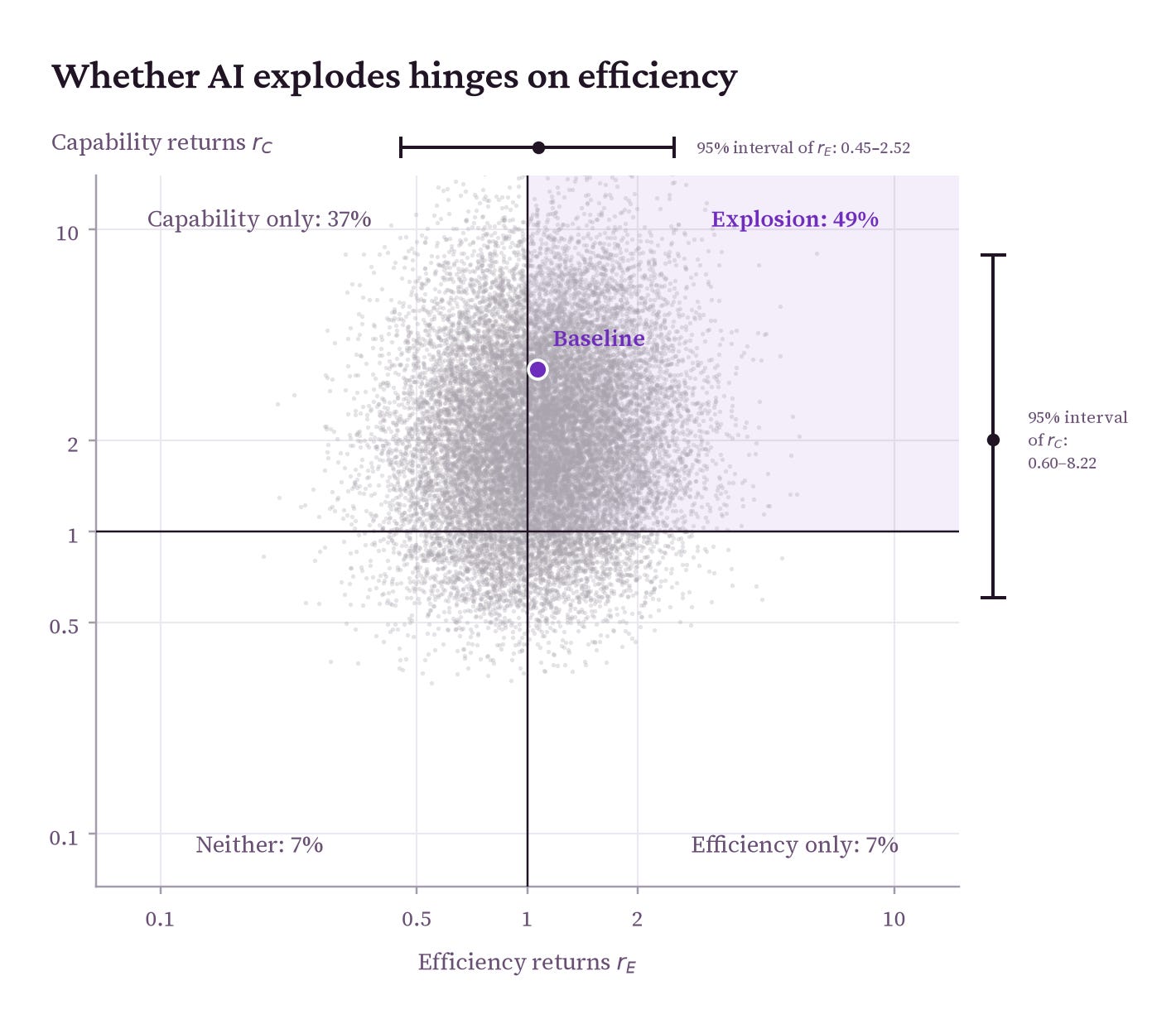
In other words: AI is probably getting smarter at the rate you would need for an intelligence explosion, but it is much less likely that it is getting cheaper fast enough for an intelligence explosion.7
What are we most uncertain about?
A key part of the value in having a quantitative framework like this is that it allows us to identify where we most need data; which parameters are the most important for determining whether we have an intelligence explosion, and which of those parameters we have the least good data on. Thus, for each input to the model, I estimate how much knowing that input would eliminate uncertainty about an intelligence explosion.8
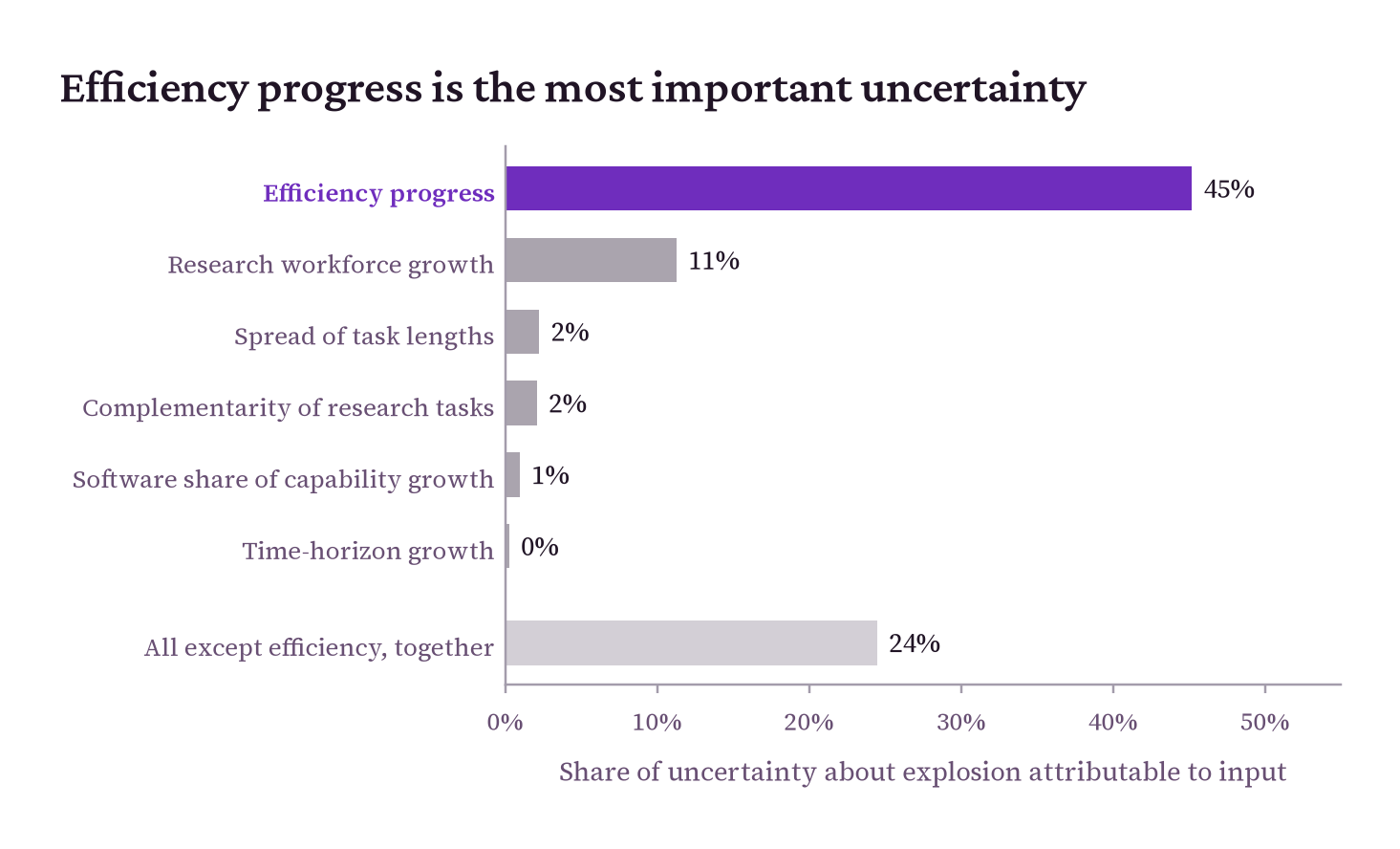
What jumps out is that the rate of efficiency progress is by far the most important uncertainty in the model. Knowing the rate of efficiency progress would resolve almost twice as much uncertainty as knowing every other input to the model combined (45% vs 24%).9 Thus, the model tells us that we need to focus most on collecting data on efficiency progress in order to understand how likely an intelligence explosion is.
What do we take away from this?
What do we learn from this analysis? Quantifying this model relies on some informed guesswork, and stitching together data from many different sources in an error-prone way. So we should be wary of drawing confident conclusions from this exercise – it’s simply the best we can do with historical data. In particular, the fact that 49% of simulations lead to an intelligence explosion does not mean that there is a 49% chance of an intelligence explosion.
There are two major issues with that interpretation:
The model only captures some of the factors that could determine an intelligence explosion. For example, it does not feature experimental compute or research taste, two factors that could hinder or help an intelligence explosion in other models.
Even if you took the model literally, the data simply can’t support a precise number like “49%” – it is too noisy, and it covers historical AI progress rather than frontier AI development today.
My main takeaways after writing this paper are:
An intelligence explosion is plausible, but uncertain. The parameters don’t guarantee an intelligence explosion by any means, but it’s more likely than you might think. This was a surprise to me! I expected the separation of efficiency and capability to show that an intelligence explosion was much less likely than people sometimes assume; instead, I ended up finding the opposite.
Efficiency, rather than capability, is the most likely bottleneck to an intelligence explosion. We may not know exactly how fast either of these margins is progressing, but it seems robustly likely that capability progress is faster than efficiency progress. Thus, we don’t need to focus on capability when considering an intelligence explosion – we can focus on analyzing the efficiency bottleneck.
We need better data on efficiency progress. Most uncertainty around the possibility of an intelligence explosion comes from one single number: how fast AI is getting cheaper to run at a fixed level of performance. Thus, we need better measurements of efficiency progress and how it responds to research effort to tell us whether an intelligence explosion is coming.
This definition of capability is narrower than the usual one. Capability here is only about which research tasks AI can do at all, at roughly the level of a human researcher. When AI gets better at a task it could already do – doing it faster, more reliably or to a higher standard – that counts as an efficiency gain in my taxonomy, because doing a task twice as well is equivalent to doing it twice as cheaply, or to having twice as many agents doing it.
I assume chips are fixed in the short-run, so that the only way to increase the stock of agent researchers is to make them more efficient to serve via AI research. I focus on this scenario because if AI developers need to wait on physical-world manufacturing timelines to produce more chips and build datacenters, this would be a natural limit on the pace of AI progress.
This focus on inference efficiency rather than training efficiency is because I focus on compute as a way to deploy agent researchers, so the important kind of efficiency is inference efficiency.
I combine a few different measures for triangulation, but the main estimate comes from Gundlach et al. (2025), who use the prices of open-weight models to infer how fast the inference compute needed to reach fixed benchmark scores has fallen.
Converting time horizon growth into capability growth – which conceptually maps to the speed of research task automation – requires a few additional assumptions that I cover in the paper. I’m also aware of the issues METR themselves have raised with taking time horizons literally, but in the paper I explain why time horizons are the most principled way to measure capability growth rate.
The reason we need to deflate progress by the growth rate of researchers is to ensure that we measure the progress achieved per additional doubling of research effort, since that corresponds to how we can measure agent researchers’ contribution to AI research.
This might be surprising to some people, because Epoch AI reports that the price of AI has fallen over 100,000x in the past five years. But this is because Epoch measures the quality-adjusted price of AI, meaning that they consider the price of AI to fall if its capability increases with no change in its cost. This is another demonstration of how it is easy to combine capability and efficiency – but for understanding the conditions for an intelligence explosion, it is important to separate them.
Technically, this is the first-order Sobol index of each input: the share of the variance in whether a simulation ends in an intelligence explosion that would disappear if we knew that input exactly, with every other input still uncertain.
These don’t add up to 100% because the inputs matter in combination with each other.