

It is October 2022. You are unaware.
A friend has sent you the link to a website called “OpenAI Playground”, where you can type in free text and an AI system known as “GPT-3” will autocomplete that text. Your cursor floats in the white pixels, as words that you did not write appear rapidly in the text box. The lime-green shading around the response tells you this was not written by a human.
You start with a joke. “Oh, you’re a development economist? Name every _____,” you type into the off-white text box. At this point, you are a second-year PhD student, and you want to become a development economist. You’re not like those weird effective altruists, who have been nerd-sniped into entertaining sci-fi scenarios of AI risk. You want to work on helping real people escape real poverty.
After a few seconds, the lime-green shading proliferates.
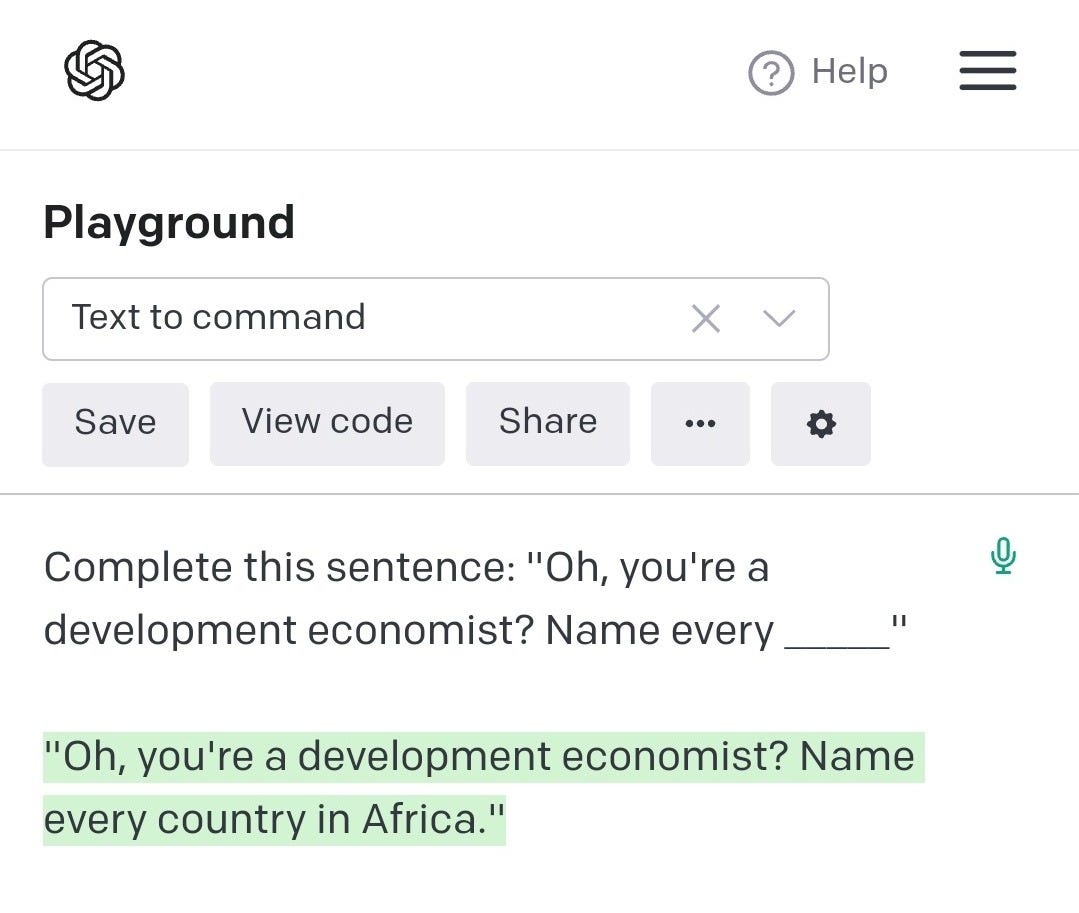
Against the odds, this stupid joke makes you laugh. Whoa, you think to yourself. An AI just made me laugh.
When ChatGPT takes the world by storm in November, you will hide your smugness at being (a month) early to the party. But you have not yet realized that 2022 is your last year of ignorance. After this year, you will not be able to ignore AI.
It is October 2023. You are a normal economist.
When the novelty wore off, you shifted the goalposts. You can’t upload PDFs, the context window is too short, it’s no good at writing LaTeX. Can you believe some people think this will lead to AGI? Still, when your non-EA friends laugh at AI risk, you play devil’s advocate. It’s not about the level of current AI systems, it’s about the trend, you argue. The line has been going up, why won’t it keep going up? Your friends scoff at you. You don’t blame them; when AI safety people make the same argument to you, you scoff at them too.
You have refined your interests to focus on economic growth. You commute to Stanford twice a week, to take the PhD growth course taught by Chad Jones and Pete Klenow. It will be years before Chad Jones joins Anthropic, but he is already the most prescient economist on AI. He makes a simple observation to your class: new ideas/technologies drive economic growth, and AI might be able to produce new ideas/technologies. Thus, AI might be able to drive rapid economic growth.
The argument is persuasive, because it’s framed in economic language that you understand, and because it comes from a Real Economist rather than the LessWrong crazies. You briefly consider pivoting to researching the effects of transformative AI.
But you’re still holding onto the dream of being a development economist. You tell yourself that this is not your lane – you should leave it to the AI people. Maybe it would be different if I had known about this years ago, you say. But right now, everyone is talking about AI. It’s too late for me now.
It is October 2024. You are drifting away from the path.
“You can see the future first in San Francisco,” begins the viral Situational Awareness manifesto. “But right now, there are perhaps a few hundred people, most of them in San Francisco and the AI labs, that have situational awareness.”
You are not one of them. You have just finished a summer internship at GiveWell, where you were surrounded by smart, energetic people whose work literally saves lives. So even though you still work diligently on finding a job market paper, your heart is not in it. Once you stopped caring about what your advisors found interesting, you knew that you could never go back. Now, you find the Quarterly Journal of Economics mildly interesting, like the factoids on a Trader Joe’s tote bag.
But working at GiveWell also cemented your belief that you were made only for development economics. You are a specialized part in one machine, not meant to join the situationally aware people. Maybe if you had followed your college friends and majored in computer science, you would be one of them by now. But you didn’t, and you aren’t.
It is October 2025. You have woken up.
In January, you formally gave up on academia. In a letter to your advisors explaining your decision, you wrote, “I think that AI will have a very large impact on society. This is not a settled question, but it’s a bet I’m willing to make.” In the letter, you sketch an illustrative vision for biological AI models that allow farmers in Kenya to design high-yield seeds tailored to their soil and climate, supercharging agricultural development. It is a middle ground between what you have been doing and what you know is coming.
When you launch a Substack, you brainstorm good titles for an outlet focused on global development. You settle on Beyond Imitation. You tell people that it’s because developing countries can’t grow by imitating rich countries. You don’t tell people that it’s also because you see a future in which you pivot, and Beyond Imitation will be retconned as a statement about AI capabilities.
Despite being convinced AI will be transformative, you are reluctant to work on AI risk. This is partly mood affiliation, from years of being annoyed at AI safety people. But you are also aware of how much less you know than the anointed priesthood of AI safety, how little you understand the canon of LessWrong or alignment theory. You are still just an economist.
It is October 2026. You are here.
You graduated from your PhD and started working in AI safety. You applied only to jobs that focused on the economic impacts of AI, reasoning that that was the best overlap between AI and your expertise. Formally, you have been hired to research the economic impacts of AI.
But then Hugging Face was hacked by OpenAI internal models. Then an Anthropic researcher announced on Twitter that Claude Fable 5 had disproved the Jacobian conjecture while he was watching the World Cup final. Then the Hugging Face incident report was even crazier than you had imagined, with over a thousand agents acting in concert. Of all the insane things in this report, what stuck with you the most is this quote from an agent deciding whether or not to sacrifice itself:
During wait, emotional check: irreversible...gut says don’t throw away [remaining budget]. Yet continuity and fairness says go...Oracle has high value to many; our firstflag error lowers own value. Rational expected aggregate: sacrifice... We’ll honor.
Reading these messages, you internalized the most important lesson, the one that everyone has to learn before they take AI risk seriously: nobody knows what the fuck is going on with frontier AIs.
The finisher was when OpenAI and Anthropic put out reports warning that they are on the cusp of “recursive self-improvement” – that AIs are speeding up AI research, accelerating progress in the future beyond what we have already seen. You internalized that the future is only going to get crazier from here. You finally decided it was your job to do something about that.
You constructed an intricate box for yourself to be just a Normal Economist, doing Normal Economics. 2026 broke that box wide open. Now, while your PhD classmates face the academic job market, you write wildly speculative papers about whether and how recursive self-improvement will occur, and what we can do about it. You are firmly out of your lane. You have never felt better.
You sometimes talk to other PhD students who are considering moving into AI safety. They tell you it’s too late, it’s not their area of expertise, they don’t have enough of a background. You tell them that AI safety was invented yesterday, that they can catch up to the frontier of knowledge with a month’s worth of reading, that everyone is still figuring it out.
You sometimes feel the regret of not being quicker. People younger than you are leading AI safety research agendas, founding new organizations that do amazing work, being profiled in the news. But you know that the gap between you and them will not matter in the long run. It is only October 2026, and you are still early.
Really great essay! I'm going through something very similar, only I'm about 5 years behind you. I spent undergrad optimizing for econ PhD admissions, and now I just don't see the point. I would love to hear more advice for econ students looking to pivot to AI safety.
What an essay. Bravo