

Housekeeping: for the next 30 days, I am taking part in Inkhaven, a writing residency in which residents publish 30 blog posts in 30 days. Fair warning: many of these posts – starting with today’s – will not be about AI safety, or economics, or any of the reasons you may have subscribed to me. If you don’t want 30 emails from me, you should unsubscribe from email notifications.
Every time I describe a city, I am saying something about Venice… Perhaps I am afraid of losing Venice all at once, if I speak of it. Or perhaps, speaking of other cities, I have already lost it, little by little.
–Invisible Cities, Italo Calvino
The Bangalore of my youth is gone. This is true in a boring sense: over the past 20 years, Bangalore has grown faster than any other city in India, doubling both population and land under use. It has added eight million people – that’s ten San Franciscos, or an entire New York City – in just 20 years. It has added an entire metro system, a new airport, at least four new neighborhoods that used to be empty fields and now are packed with high-rises.
But the real reason the Bangalore of my youth is gone is because the Bangalore of my youth existed only for me.
I arrived in Bangalore at four years old, having only lived in the New Jersey suburbs, with no sense of a city – let alone one as intense as Bangalore. My apartment complex was next to a chaotic road, a five-way intersection with irregular angles and no traffic lights or crosswalks in sight. Crossing that road was terrifying to me, and I would often make my parents carry me. My apartment complex was full of monkeys that were smart enough to take advantage of my terror. I often couldn’t play with the other kids because I would have to pass a monkey chilling in front of our elevator. Stray dogs would smell my weakness, and menace me until I surrendered my snacks.
I didn’t understand my new world. When I asked her, my mother told me that we had come to Bangalore on a bucket over the Atlantic Ocean, and the journey had taken six years. I accepted this claim; it wasn’t like anything else about this world made sense to me.
China Mieville’s The City and the City details a murder mystery that takes place across two neighboring cities. But they’re not “neighboring” like East Berlin and West Berlin. Instead, they occupy the same physical space, and residents simply unsee the people and buildings from the other city. Cars sail past each other without acknowledgment. Two families can live next to each other for decades, pick up the newspaper from their front step at the same time, but never see each other across the invisible city walls.
Unseeing is the core experience of urban life. It is what allows for the experiences of a thousand people to fracture into a thousand unique stories, for one city to have a thousand shapes. It allows this idiot to project his own narrow obsession onto a place much more complicated than he can understand:
Unseeing is how I learnt to love Bangalore. By the time I was a teenager, I would cross the chaotic road while tapping at my phone, and I would ignore the dogs and monkeys. Once I unsaw Bangalore, I started to see my Bangalore. My Bangalore was the enterprising slum children next to our apartment complex who sold our tennis balls back to us for a profit when we hit them over the wall. My Bangalore was sweaty software engineers packed like sardines on the buses to exurban office parks, street food vendors who had moved from their villages to make it big in the city, rickshaw drivers charging “wonandaaf” (1.5x meter price) after 9 pm, uniformed girls with long braids jumping over potholes on their walk to school, trees growing out of the sidewalk and in the middle of roads. All of us occupied the same streets, unseeing different things, living in parallel cities.
2027 will mark the turning point, when I have lived in the US for more years than I’ve lived in India. That divide used to fill me with dread, and I still demur when people ask whether I consider myself Indian or American. “India” and “America” are too big to fit inside an identity, too abstract to feel attached to. But Bangalore was real to me in a way that other proper nouns weren’t. While I couldn’t tell you whether I was from India or from America, for a long time I could tell you that I was from Bangalore.
I can’t tell you when exactly I stopped being from Bangalore. It was a gradual process. Maybe it was when I returned to Bangalore and felt the air pollution grinding at my lungs for the first time. Maybe it was when I revisited my old after-school stomping grounds, and the shops were all gone. Maybe it was when the slum next to our apartment complex was bulldozed and replaced with a high-rise. Most likely, it was none of these things, and my alienation was simply a result of becoming more entrenched in the US, and growing distant from the things that used to define Bangalore to me.
There are precious few remnants: the crisp golden dosas at Bangalore Cafe, the stationery store where I used to buy pens for school (always gel pens, never ballpoint pens), the dusty shelves piled high at Blossom’s Bookhouse.

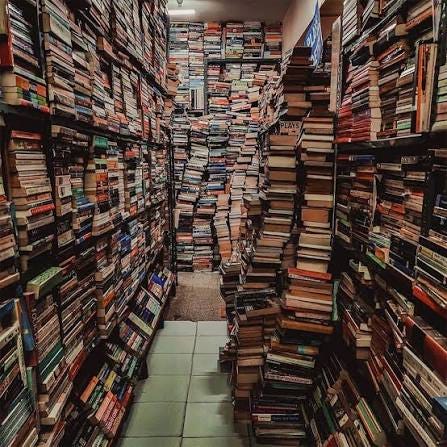
On my annual trips, I dutifully make a pilgrimage to each of these places during my first few days. Then I spend the rest of my days at Blue Tokai, a new third-wave coffeehouse for young professionals and digital nomads.
You need to understand that none of this is a bad thing.
South End Circle is a six-way intersection in my childhood neighborhood. Its name comes from a time when it marked the southern border of the city, and everything south of it was agricultural land. But South End circle is two miles north of my house. All of my childhood wonders, the chilli cheese sandwiches that I begged my parents to buy me, the theater where I took drama classes, all of that took place in a neighborhood that some old-timers would view as an unwelcome outgrowth of their beloved city.
I despise the grabby nostalgia that makes intelligent people cry foul at every change in their hometown. Bangalore is home to twice as many people as it was during my childhood. Twice as many people get to experience its joys, its idiosyncrasies, its terrible traffic. My memories of Bangalore are frozen in time, but the real Bangalore is a living organism that grows and mutates. My desire to return to my childhood is not a reason to hold the city in perpetual childhood.
I will likely never live in Bangalore again. But Berkeley has become my new home, and I’ve lived here longer than anywhere but Bangalore. What will I feel if I return to Berkeley in 20 years? Will the Berkeley of my youth be gone, too?
I hope so. I want the city I love to grow, to become a canvas for new stories, rather than reenacting my youth. I want to see it anew, to fall in love a second time, and then a third time. If I do, that love will be on its own terms, not a bid to recapture my glory days. If I don’t, the city will still be a bonfire of other people’s dreams.
as someone for whom bangalore only exists post-2021 and in my young adulthood, this was a really fun read <3 and a good cities book to add to the list