

With AI and math, we are watching in real time as an academic discipline gets comprehensively solved. Mathematicians go through an existential crisis, wordcels complain about how Numbers aren’t actually Important, the world goes on. But a key part of processing AI’s impact on math is realizing that math is not actually very… useful. AI revolutionizing math is a bit more like AI revolutionizing chess – a sign of progress, but not an end goal in itself. We would have felt very differently if AI had solved biology or chemistry instead, fields with clear connections to technological progress and prosperity. But AI solving math makes me wonder what would change if it solved economics too.
So let’s skip to the end, after AI becomes better than top economists at every element of research, but before it kills everyone. Specifically, let’s imagine that AI could identify all the most important questions in economics, write the best theoretical model to answer them, and do the best data analysis with the most credible research design. The only limits are two human-imposed restrictions – that AI needs human proxies to access restricted data (e.g. Census data), and it can’t run experiments in the real world. Holding fixed AI’s impact on everything else1, how much value would automated economics research provide to society?
I asked this question to a bunch of my friends, and to Twitter. Most of the answers I got were jokes, even though I meant the question earnestly. It seemed like nobody was optimistic. A few people mentioned general improvements to public policy and program implementation. Another friend pointed out that businesses might steal surplus from consumers – right now only a few companies like Amazon and Uber can employ fleets of economists to help them squeeze consumers, but AI could democratize that. This is also plausible to me, and it has ambiguous welfare effects. Still, markets would become more efficient, which is probably at least a little good.
With humans running out of good ideas, I put the same question to AIs. One snippet of Fable’s answer stood out to me:
The labor-constrained parts of economics explode. Thousands of zoning reforms, local minimum wage changes, and procurement rule changes have never been evaluated because no one had the time. That long tail gets studied, which mostly helps places that can’t hire top economists: city councils, state agencies, and finance ministries in poor countries. I think this flattening of expertise is the largest welfare gain.
This makes sense to me: the sectors most affected will be the ones with the fewest economists right now. AI is already flattening expertise this way in other fields. For example, AI democratizing legal expertise means that people are more willing to file cases without a lawyer. Perhaps AI democratizing economic expertise would mean that organizations without a full-time economist are more likely to follow established economic findings. They might be better able to use the data they already collect. That could be worth something.
By contrast, national economic policy might be mostly unaffected by an explosion of economics research, since it is mainly constrained by politics and institutions. Central banks and national governments also already employ many economists, so extra research runs into diminishing returns.
So there are definitely things that could improve a lot with abundant economics research. But on the whole, I can’t say these differences strike me as enormous.
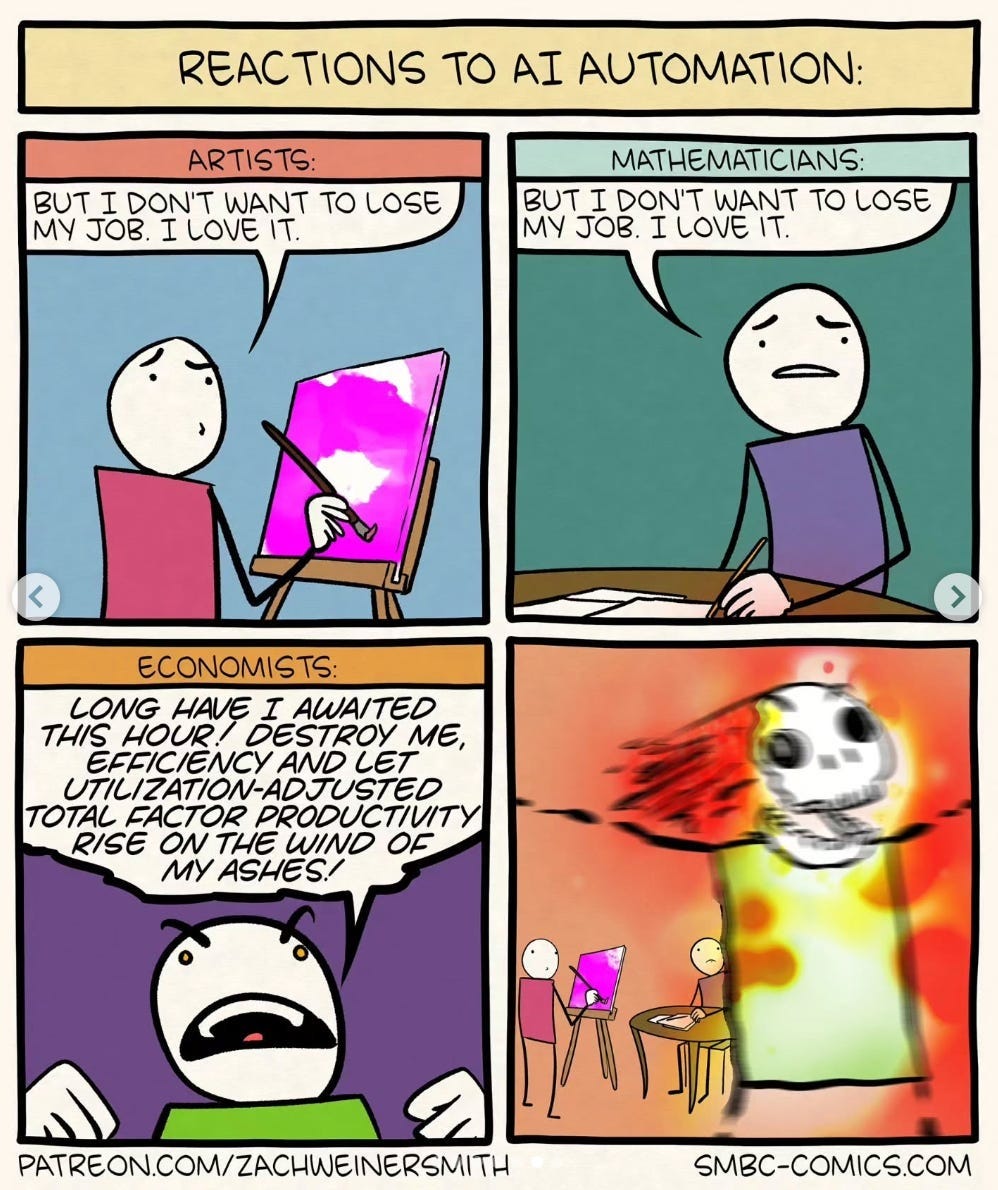
Every economics PhD student I know has thought about the possibility of AI solving economics. None of them has the attitude in the comic above. Understandably, they think in terms of their own future. They fear that their expertise won’t be necessary and that they will become social deadweight.
A quirk of my own field that I’ve only understood in the past few months is that AI safety researchers fear the opposite outcome. We’re scared that we will be necessary, that we won’t be able to hand off AI safety research to AIs and 1000x our effective workforce. This is easy to understand when you consider the world-historical sense of importance that AI safety confers on you and your work. That psychological comfort is an underrated perk of working in AI safety.
I am not better than anyone who worries about their future, and if this comes off as holier-than-thou, I have failed. But I am not depressed by the possibility that economics will be automated. I am depressed by the possibility that economics will be automated, and nothing will happen. The gears will speed up, but it will turn out this machine served no function after all.
You could also include the value of solving economics-adjacent fields like political science. And if AI solved economics, I expect it would solve those other fields too, and those effects could be quite large. But the point of this thought experiment is to understand the value of having economists around, and I probably shouldn’t credit all quantitative social science to economists, no matter my prejudices.
Great post! That being said if we solve health economics we end up with very good health advice at least I would guess. Not as good as solving biology but it would help somewhat. I agree that subnational governments would benefit but it seems like if there's also a quality improvement that helps the people who currently hire economists. Even in domains that are politically constrained like immigration there's probably some Pareto improvements to be had if our AI economist can find them. This is getting outside economics but if you have sufficiently good data there's enough overlap in the skill set that it'd be good at designing certain portions of public transit and infrastructure projects (like rider demand estimation, maybe estimating costs, potentially forecasting public approval) I think? Anyways this is an interesting question.